

You saw the signs, read the mail, and heard the spin, but the real story behind the 2026 Primary Election is in the numbers. The CWJ team has been digging into the data from the March Republican Primary, and although we work with counties across Texas, we decided to share some information about our home county: Smith. Here’s what Smith County turnout tells us.
A total of 29,924 voters cast a ballot in the 2026 Republican Primary, compared to 30,638 in 2024, a slight decrease of just over 700 voters. At the same time, overall turnout increased from 22.96% of registered voters in 2024 to 27.82% in 2026. That increase came from the Democratic side of the ballot.
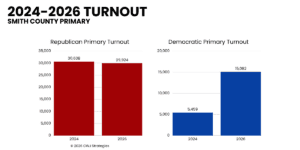
In Smith County, most of the increase in Democratic turnout came from people who regularly vote in Democratic primaries, or those who usually only show up for general elections.
About half of Democratic primary voters had voted in previous Democratic primaries, while another 35% were people who typically only vote in general elections. The remaining 15% either had no voting history or had voted in previous Republican and Democratic Primaries. We heard some wonder if Republican voters were switching over to vote in the Democratic Primary, but the data shows the increase came from higher Democratic and general election voter participation, not crossover voters.
Looking at the Republican turnout data, more than 82% of voters in the Republican Primary had a history of voting in Republican Primaries, and over half (51%) voted in both of the last two Republican Primaries. This continues to reinforce the same reality: Republican primaries are decided by habitual voters, not occasional ones.
But where did Republican Primary turnout actually come from?
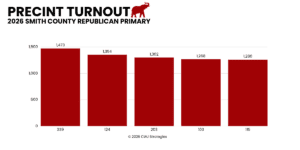
Looking at Republican turnout by precinct, the turnout was concentrated in a handful of high-performing suburban areas. The top precincts were 339, 124, and 203, followed closely by 103 and 115. These precincts are primarily located in Lindale and South Tyler, along with the surrounding suburban growth areas, all of which continue to produce strong Republican primary turnout. You can find a precinct map here.
So what was pushing voters to the polls?
This wasn’t just a top-of-ticket driven cycle. Turnout was also fueled by competitive, down-ballot races, particularly at the county and precinct level. These kinds of races don’t always make headlines, but they absolutely mobilize reliable Republican voters who understand their local impact.
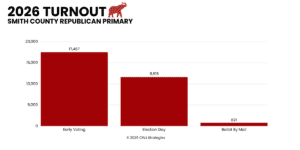
Early voting continued to dominate turnout, with voters taking the opportunity to vote with shorter lines.
So what does it all mean?
Turnout doesn’t happen by accident. It’s about knowing who your voters are and making sure they get to the polls.